by CJ Quines • on
Video game March
find matt’s cats, diceomancer, rhythm doctor, cobalt core
It’s been ten months since my last video game blog post, and I’m still figuring out how often to make these. Anyway, some recent games I’ve played.
Find Matt’s Cats
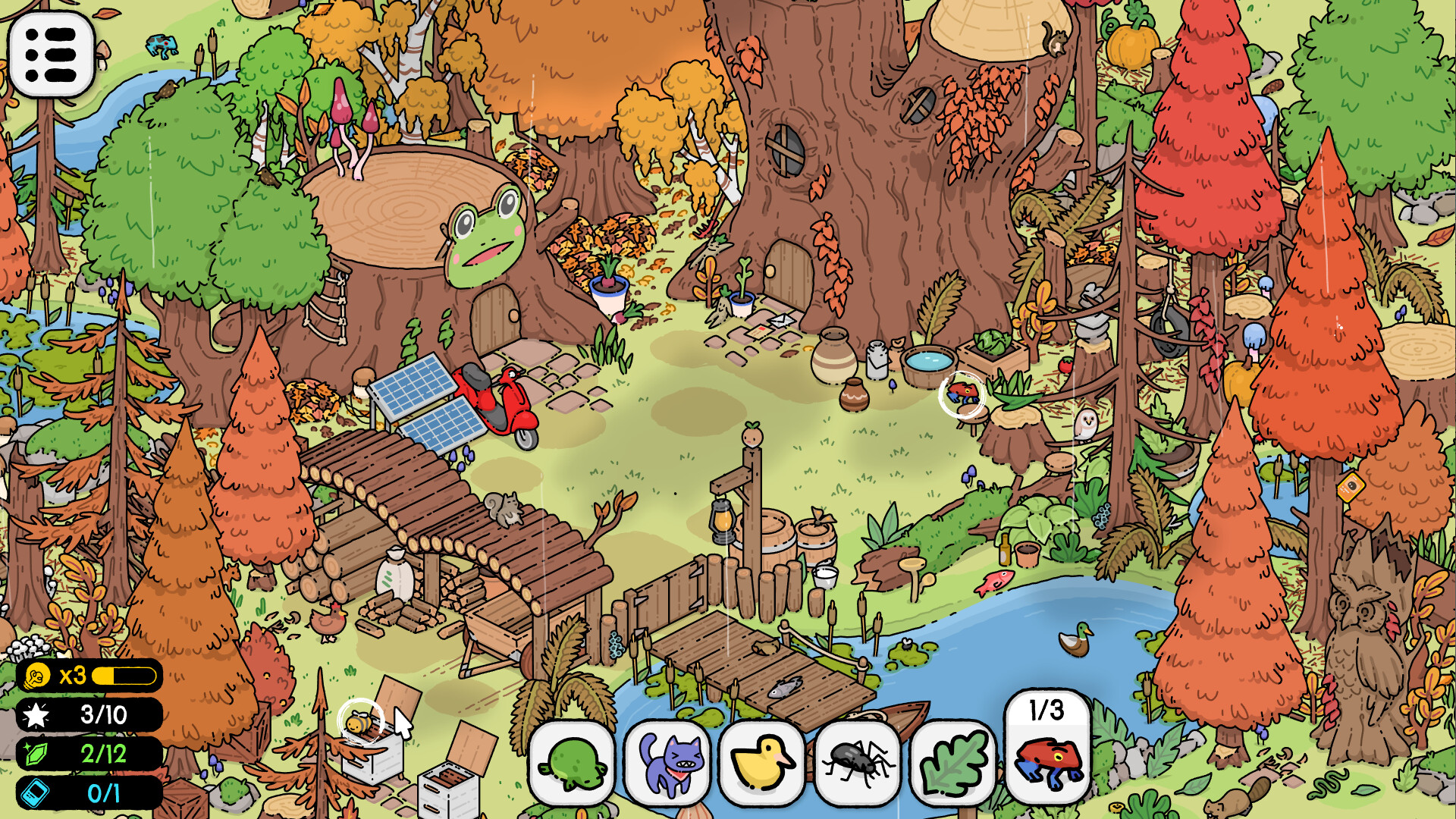
I’ve once played Epic Battle Fantasy, a series of turn-based RPGs by developer Matt Roszak. That’s how I learned of his latest game, Find Matt’s Cats, which stands as a genre departure. It’s a huge, hand-drawn, charming, and dense hidden object game. That also makes it a genre departure for me, as I don’t have a huge library of cozy or casual games. Yet I’ve enjoyed it, which is high praise.
The bulk of gameplay is about clicking things. Most things I’ve clicked aren’t the hidden objects themselves, but the clutter and background elements around them, because I’ve found great joy seeing how each thing reacts to being clicked. The lanterns swing around, the pots break, doors swing open, frogs jump, cats disappear in puffs of smoke, and everything has a sound effect. There’s 84 levels, each with a different set of hidden objects per difficulty, and their own collectibles. Some levels have special goals for finding all copies of a certain object, for the achievement-hunters out there. And there’s plenty more small mechanics I haven’t mentioned. All of this adds up to an incredible amount of care and polish.
I’ll admit that the nostalgia shares a small part in my enjoyment. The game is littered with references to classic Flash games and twenty-year old memes. The story is a meta-narrative of sorts, where you play as a beta tester for Find Matt’s Cats, and interact with the four friends who are developing the game together—the same four characters from the Epic Battle Fantasy series. And while I’ve never been a real game developer, I certainly relate to the struggles that play out in the little cutscenes between levels. Not that you’d play this game for its story, but it’s there and it’s often funny.
I’m a little worried that, after a few more hours of gameplay, it’ll get same-y. The hugeness of the game feels a bit daunting for a stalwart completionist like me, and I’m faced with the prospect of not seeing everything the game has to offer. But I’ve already played the game for seven hours, and I haven’t gotten bored yet.
DICEOMANCER
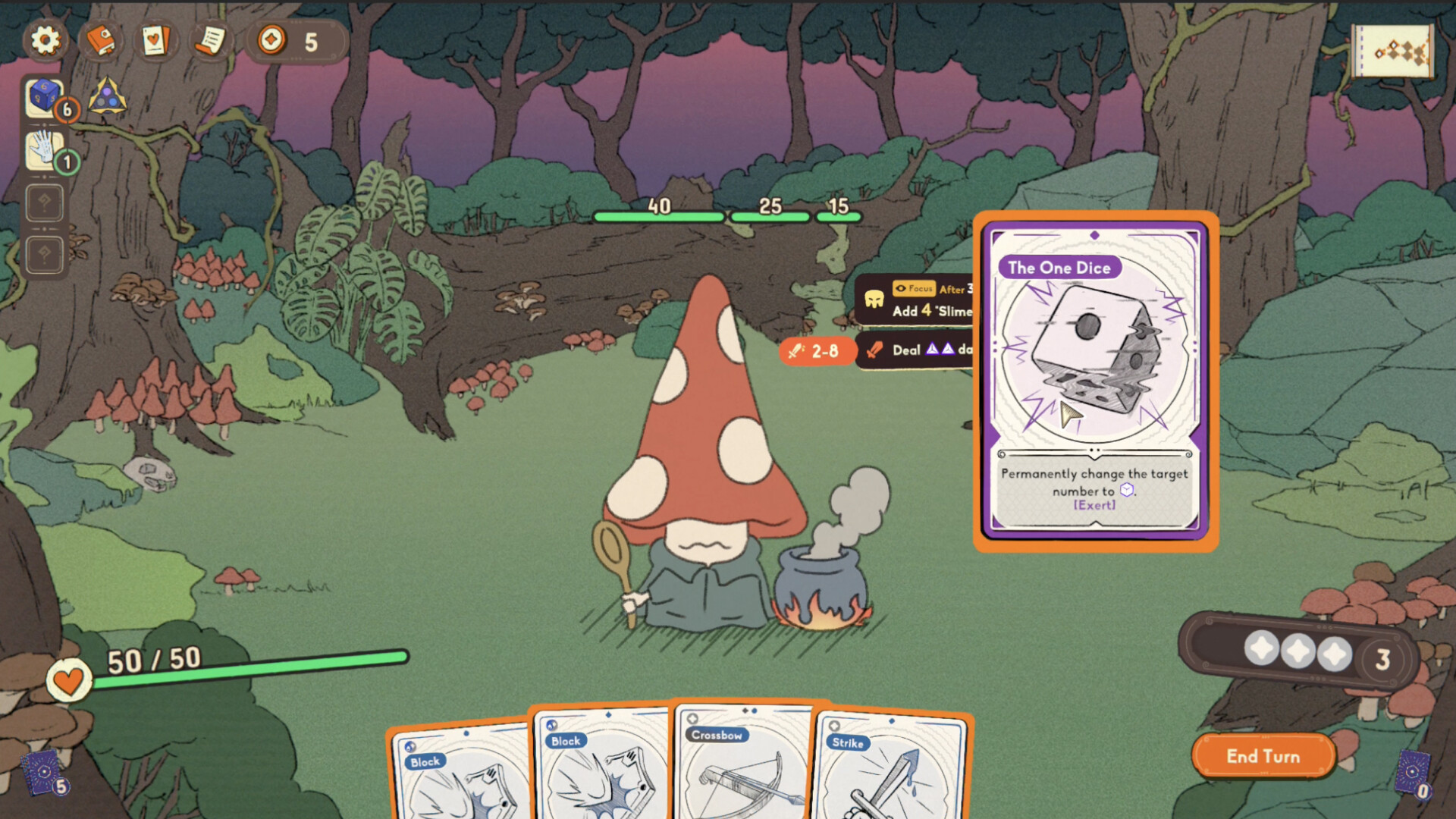
The main conceit of deckbuilding roguelike DICEOMANCER is that you can replace any number with the result of a die roll. The gimmick contributes to the game’s general chaos, with its absurd story of fighting eldritch horrors and woodland creatures so you can go fishing, and its gorgeous eight frames-per-second hand-drawn animations of enemies and card effects.
And I do mean any number. There’s numbers that you’re more-or-less encouraged to change: enemy health, amount of energy, card effects, relic charges, money. But I’ve been delighted with how versatile the number-changing mechanic is. Some numbers are so deeply engrained into deckbuilding roguelike tropes that I’ve ceased to think of them as variable numbers. Choosing between three card rewards, drawing five cards per turn, cards exhausting after one play: in this sense, the game makes metatextual commentary on the genre. It’s probably best appreciated after you’ve played other such games.
I thought, at first, that this mechanic would make the game trivial, but there’s enough balances in place to limit its power. Requiring you to use a resource is one of them. Cards with changed numbers will advance the impending doom following you on the map. Enemies all have multiple health bars, so you can’t one-shot their health down to a small number. Multiple types of energy costs prevent you from playing all your cards every turn. And yet, every time I use the die, it still feels like I’m breaking the game with my cleverness, and fulfilling my fantasy of doing overpowered nonsense.
If you come into this game expecting the depth of something like Slay the Spire or Monster Train, you’ll be disappointed. There’s a good one-or-two dozen hours of gameplay before you get most of the meta-progression, and see most of what the game has to offer. The base game isn’t that difficult, and the ascension system doesn’t add much difficulty while looking quite grindy. DICEOMANCER isn’t a game that’s meant to be played for hundreds of hours, and it doesn’t have to be.
Rhythm Doctor
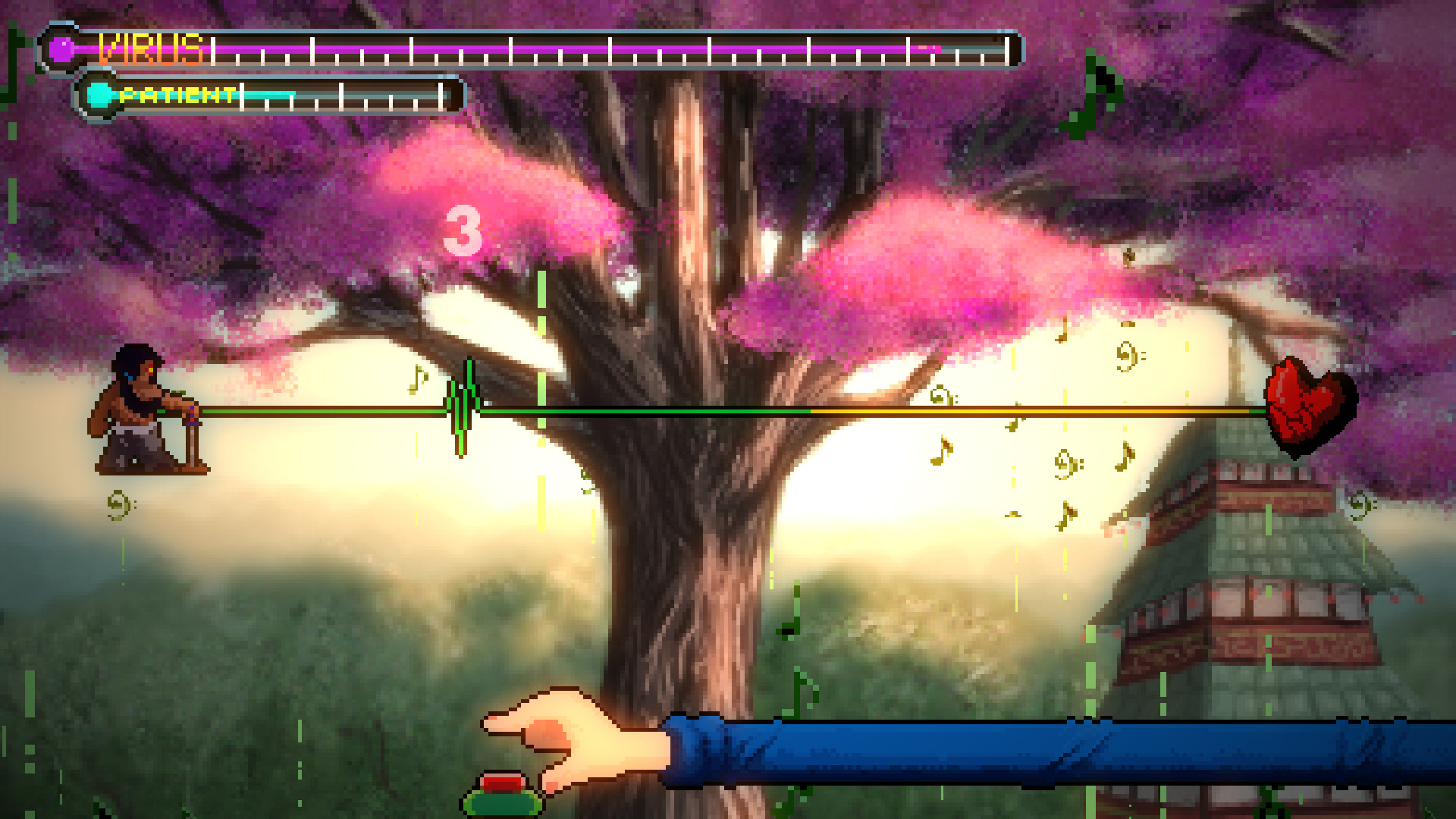
Rhythm Doctor is a difficult and story-rich one-button rhythm game, in the spirit of Rhythm Heaven. It’s a tour de force demonstration of the variety of things you can do within relatively constrained mechanics.
Rhythm is the showcase tool. It starts with hitting a button on the seventh beat. Then you get skipped beats, tempo changes, swing notes, triplets, other kinds of syncopation, and irregular time. In sequence, with tempo changes, with rhythm changes, and all at once. And all of this is possible to track with one button, although it’s sometimes easier to use two. Not that you’d need to know any music theory to play the game, as there’s ample tutorials and good pacing.
The rhythmic variety is matched with its musical variety. Backing tracks span genres from classical to dubstep to showtune to techno, and they’re all bangers. The story is tightly integrated with the gameplay: our player-character participates in a remote defibrillation internship, and each level’s patient has rhythm and music chosen to match their story. This slightly meta narrative justifies its leaning on the fourth wall when the game starts playing with the interface, which it does often.
The fundamentals of Rhythm Doctor are strong, which makes replaying levels to progress in the game less painful. The studio describes the game as “tough-as-nails”, and I’m not ashamed to admit that I had to adjust the difficulty to get through some levels. The game comes with many knobs for doing so, and it has a strong focus on accessibility, though I’m not sure if the defaults are a tad overtuned.
Cobalt Core
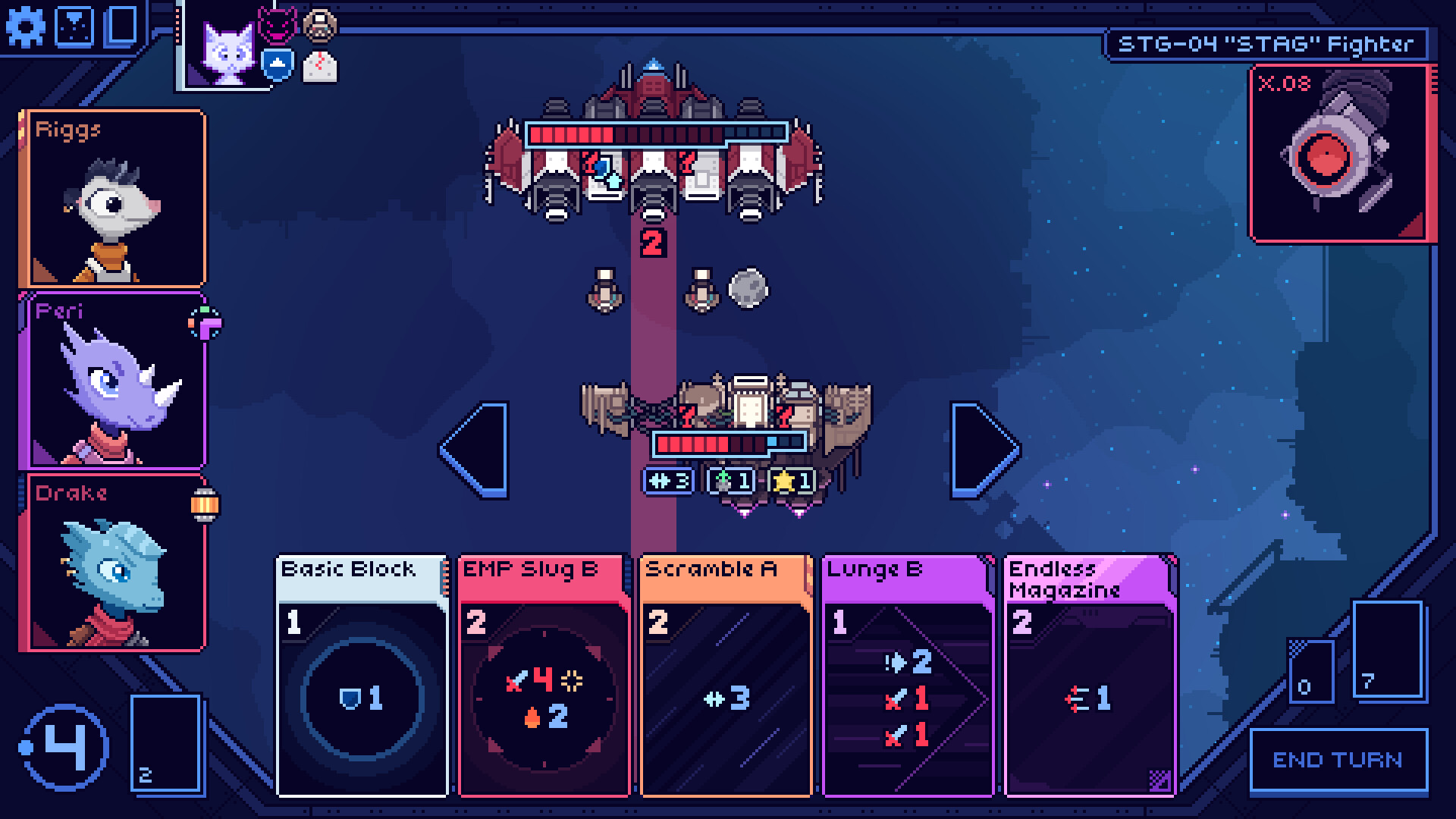
I am not beating the allegations of “only plays deckbuilding roguelikes”, because I have been playing Cobalt Core, which is another wonderful deckbuilding roguelike. It’s also a turn-based tactics game, in the vein of Shogun Showdown or Into the Breach.
There’s the usual combat formula of shooting and blocking, and the usual deckbuilding formula of energy and card manipulation. To these, the game adds the element of positioning and movement. You can prevent damage by raising shields, but you can also dodge out of incoming fire. This also matters for offense, as many enemies have weak spots, and some attacks disable the part they fire at. So sometimes, turns play out somewhat like a puzzle. And sometimes, you draft the cards that let you ignore the puzzle and shoot the enemy with abandon.
The story involves a crew of anthropomorphic space critters stuck in a time loop. While the plot is sparse, each character brings their own charming personality, which shines in little bits of battle dialogue and event text. I found myself caring a little more about each cast member than I would in other games in this genre. I’d argue that the main meta-progression comes in the form of memories, which are brief cutscenes centered on each character.
My caveat for DICEOMANCER applies here as well: expect tens of hours of gameplay, not hundreds. It’s not that Cobalt Core isn’t challenging, but there isn’t a lot of content and variety. I’m before the point where runs start to feel same-y, but I worry it’ll happen before I see the game’s ending.
Honorable mentions
(the) Gnorp Apologue is an incremental game. Unlike many incremental games, finishing this game requires a thought-out strategy and good decisions. Mistakes can be punishing enough to warrant resetting without getting anything in exchange. I enjoyed this aspect, but someone expecting an idler might get put off. I also enjoyed the graphics far more than I expected I would.
Cult of the Lamb gets referenced in several deckbuilding roguelikes I’ve played (usually the mods), so I expected the game to be a deckbuilding roguelike. While it does have a hack-and-slash dungeon-crawling roguelike part, that’s only around a third of the gameplay. The remaining two-thirds is the city-building aspect, which I wasn’t expecting at all. But, much as I enjoyed Rimworld, I happened to like that aspect too.
The Rookery is a chess puzzle roguelike. The actual chess skill needed is rather minimal: I got by with knowing the rules and the basic checkmate patterns. The art and music is, uh, tolerable. The content itself looks quite deep and rich. But, after two or three runs, the game just hasn’t captivated me. I’m not a big fan of puzzle games in general—and make no mistake, this is a puzzle game—so I’m not too surprised.
Slay the Spire 2 is so popular that half of my active Steam friends have played it, so I don’t even know why I’m talking about it. I’ve played enough modded Slay the Spire that I don’t feel compelled to play its sequel until it’s further developed, at least in singleplayer. But the multiplayer is delightful, even if I find the slow animations mildly grating. If you haven’t played the original, skip that and play this instead.
Peglin is a pachinko deckbuilding roguelike. It doesn’t have particularly deep strategy, as none of the choices you make have that many options, and much of how any given fight goes depends on the randomness of an orb bouncing around a pegboard. Then again, I haven’t played that much of Peglin, there’s been a recent huge major update, and I haven’t played it since, so maybe things have changed? It’s good fun nonetheless.
Uncle Chop’s Rocket Shop has a singleplayer Keep Talking and Nobody Explodes at its core, coupled with some shop-management mechanics and a mystery story, all wrapped in a roguelike. But perhaps its ambition stymies its quality: the meta-progression feels weak, runs quickly feel tedious, bugs abound, and controls are wonky. Games you wish you could love, but can’t quite.